Nova Scotia MP Chris d’Entremont says his decision to cross the floor from the Conservatives to the Liberals was motivated by what he called Pierre Poilievre’s increasingly hostile leadership style.
d’Entremont said he wanted to take a more constructive approach to Canadian politics and no longer felt aligned with the Conservative Party’s tone or priorities.
The MP announced his move on Tuesday, appearing alongside Prime Minister Mark Carney at a post-budget news conference in Ottawa.
“In the last number of months, I wasn’t feeling that I was aligned with the ideals of what the leader of the Opposition had been talking about,” d’Entremont said.
He added that no positions or incentives were offered in exchange for his defection.
“In my case, as a Nova Scotian, we’re always trying to find ways to work together to solve the issues that are important to our communities. And I didn’t see it by sitting in the Opposition, I saw it by being part of the government caucus,” he said.
The move has sent shockwaves through Parliament and reignited debate about the ethics of floor crossing, when an elected MP changes parties without facing voters again.
“Everybody likes floor crossing when they’re gaining a member and cries foul when they lose one,” said Matt Farrell, a political science professor at Fanshawe College. “It can be kind of sketchy, especially if voters and donors supported that MP based on the original party.”
Farrell said d’Entremont’s switch could signal further movement among moderate Conservatives who don’t feel represented by Poilievre’s leadership style.
The change narrows the gap to a Liberal majority, leaving the government just two seats short of the threshold.
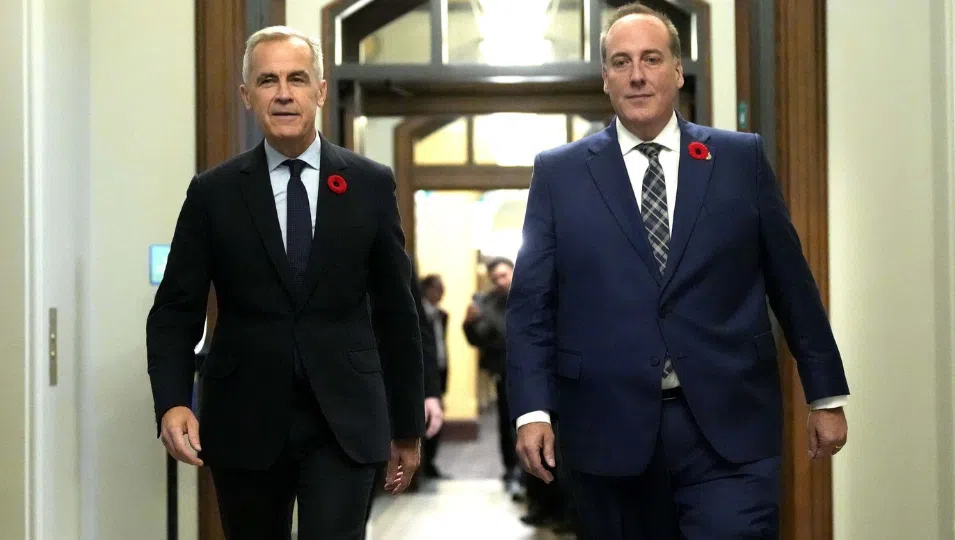
Prime Minister Mark Carney walks with MP Chris d’Entremont, who crossed the floor from Conservative caucus to join the Liberals, to a meeting of the Liberal Caucus on Parliament Hill in Ottawa, on Wednesday, Nov. 5, 2025. (THE CANADIAN PRESS/Justin Tang)



