

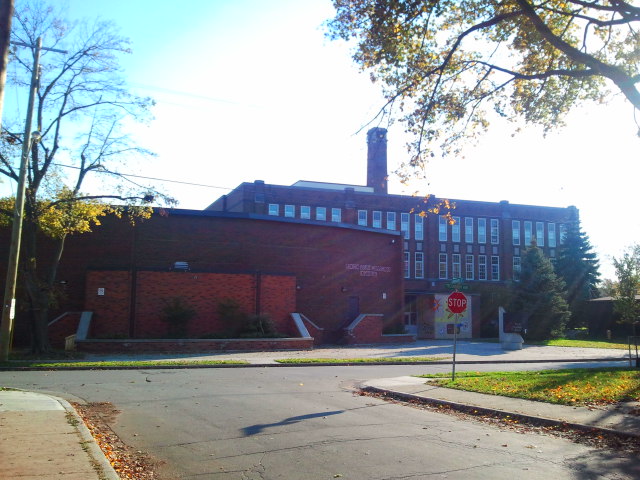
CREDIT: Wikipedia
Announced in July, de-streaming courses will begin in the Fall of 2022 for incoming students.
Ontario is the only province left in Canada to continue with the separation of academic and applied courses.
The goal for de-streaming classes is to disable barriers of perceived academic ability. In taking away the dividing culture in the classroom, the Ministry of Education is hopeful this will curate a path for more graduates.
Sandra Lowden has been teaching high school for 30 years and is questioning the decision to implement de-streaming in a time where the pandemic has already caused bumps in the road to education.
“I think for one thing, as everything’s coming out of COVID, this is the wrong time to introduce such a new policy. And the other factor is that I’m not sure I’m in agreement with that. Students do have strengths and weaknesses when they’re entering high school. Most of them know where they’re strong and where they’re weak. I think with the overall idea that if they could decide a little later that that might be the good part of the de-streaming idea, but the idea that they can all perform as the same in the same class is a little difficult still.”
With incoming freshmen entering high school next fall, London South Collegiate Institute graduate Matt Kyle is also unsure of the upcoming changes for future students.
“Being someone that was never really good in school I would say no, I don’t think it’s going to help at all,” said Kyle. “I know I barely even passed my applied classes. Why would I want to be thrown in academic ones? I think the whole applied and academic situation is good enough as it is because it one gives people that that age, the choice, and it gets them into the idea of making choices for themselves.”
In the dividing of students between academic and applied, students who took lower-level classes were less likely to graduate and pursue further education.
“I don’t think I would have ever been able to do academic classes. I’ve got ADHD, so focusing in school was never my strong suit. I always chose the applied classes and even then in some of the courses, I didn’t do a good enough job. I passed, barely. But I don’t see why they would decide to put the two together.”
Kyle believes the de-streaming could do more harm than good for students who struggle in lower-level courses.
“There are people out here that struggled to even get the bare minimum, and now they’re trying to throw them in a class where let’s say class average, for example, is going to be anywhere between 70 and 80 per cent. Some people just can’t genuinely achieve that, and then they go home and have to feel the repercussions from their parents because of that.”
While de-streaming launches next fall for classes, it has already begun this fall with math, and Physics teacher Ryan Klimowski is more accepting of seeing the de-streaming in action.
“The way that it was that when people went into grade 9, they pick academic or applied. One of the concerns was that when they pick academic or applied, they usually hard lock them into a program. What I mean, is that people that went into academic were a lot more likely to continue on into university studies and people that want to do applied rarely did. The goal was to push back the actual time on which you’re making these important life decisions.”
CREDIT: iStock
With math having a preview on what de-streaming can look like, the curiosity remains on how it will impact all courses moving forward.
“It definitely has an effect on everyone’s classes, purely just because you have some of these applied students who do better with a little bit more guided learning in these larger classroom sizes. They’ll have a slightly different learning experience than they would have had before.” shares Klimowski. “It should be interesting to see how geography and history get affected. A lot of people speculate that math is one of the ones where it’s going to be most affected just because of how large the gap can usually be between mathematic skills.”
A pattern of students affected fall under low-income and racialized households.
“I could also see it being really really large with those English skills as well, especially a lot of for the English as a second language students being brought into the de-streamed classes. So overall, I think the idea is good. As long as the classroom sizes are small.”
For incoming students gearing up to enter grade 9, there is a set of emotions including frustration and anxiety that swirls the minds of both educators and freshmen.
“I can see it definitely being irritating. Especially when you have the students who really do need the extra help. They just aren’t able to get it. Definitely understanding that there’s a lot of people that are not too happy with the changes, especially right now in a pandemic is not ideal.”



Comments