You might have noticed you’ve got an extra hour of sleep on Sunday. This is because of ‘DST’ or ‘Daylight Saving Time’. Which means, in spring our clocks move an hour forward and in fall an hour backwards. Not all of Canada got that hour of extra sleep.
Not everyone is a fan of this system. In fact, less than 40 percent of countries worldwide use it. Not even every municipality in Canada uses it.
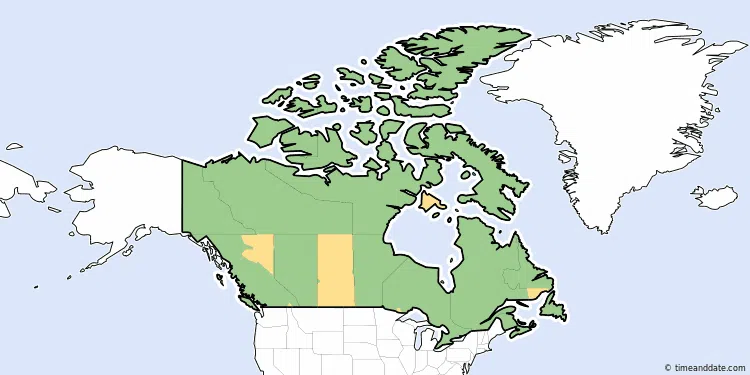
Green: Areas in Canada using DST in 2019
Yellow: Areas in Canada on standard time all of 2019
(credits: timeanddate.com)
The legislations in each municipality can decide for themselves. Most of Saskatchewan and small parts of B.C., Quebec and Ontario are not using DST.
Goodbye DST?
Currently the government of British Columbia is taking steps to end DST in the province.
Also in Ontario, former MPP member Marie-France Lalonde introduced a private member’s bill in April to keep Ontario on Daylight time all year long.
Origin
Originally, the time shift was introduced to make better use of the sunlight in the summer and in return, use less artificial lighting in the evenings.
The first time DST was used in Canada was in 1908.
Today many studies disagree on the usefulness of this time shift twice a year. There are studies concerning mental health, energy saving and even road accidents.
Online Canadians have different opinions about DST.
These days are gone #DaylightSaving pic.twitter.com/zO9DyJu1Yr
— JRPatterson☘️ (@JPintheLDOT) November 3, 2019
https://twitter.com/KassandraSeven/status/1190787184938438661?s=20http://
It's just 10pm. Feels like 12 #daylightsaving
— hmd (@hmdxli) November 5, 2012



