

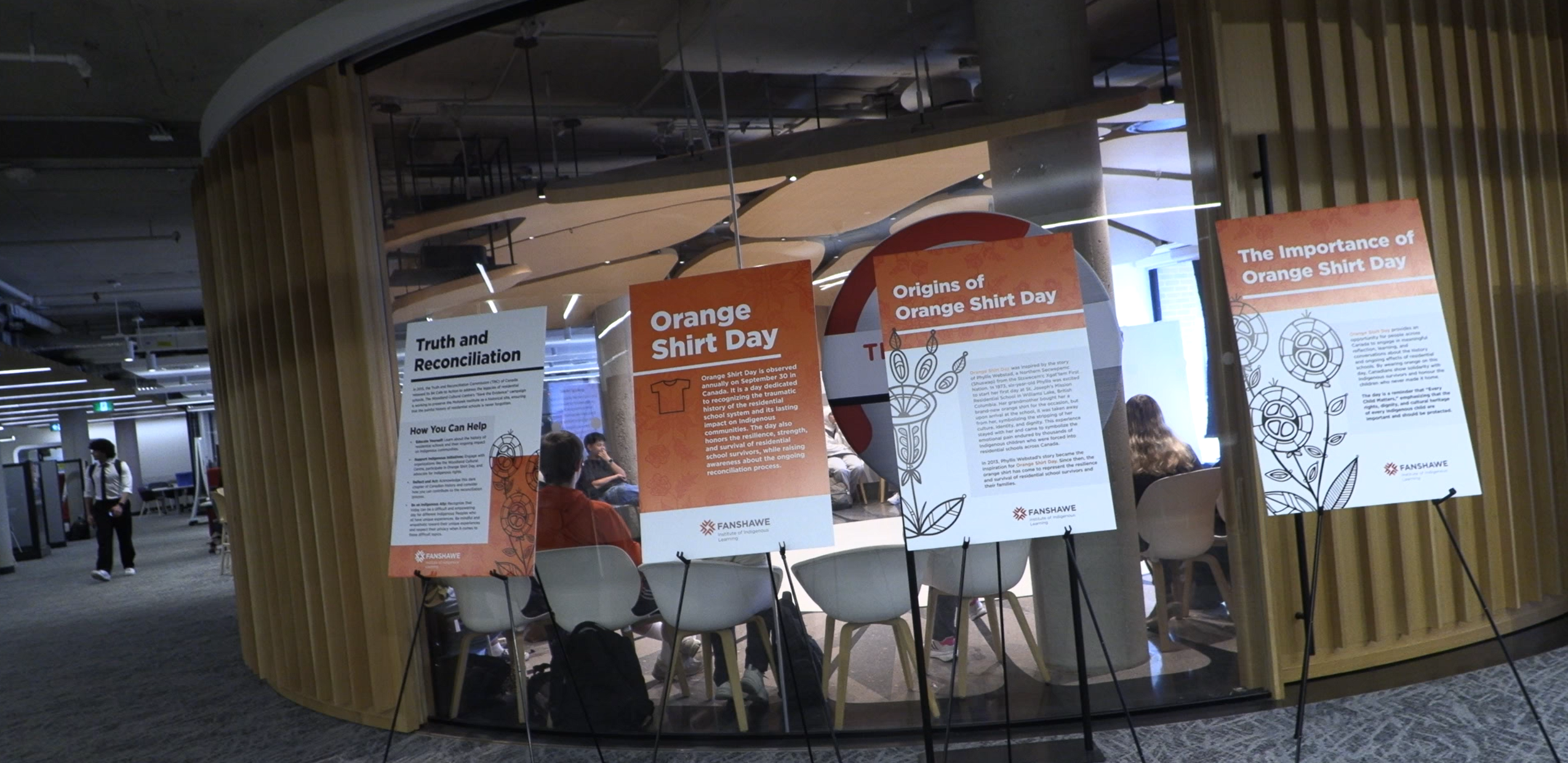
Fanshawe’s students are honouring Indigenous students on Truth and Reconciliation day through many ways. Included are an art gallery displaying artwork created by Indigenous students, an Artisan market to support Indigenous businesses, and a speaking event where Ray John Jr, an Indigenous educator, and Pam Tobin, the CEO of the Canadian Mental Health Association, Thames Valley Addiction and Mental Health Services. Tobin and John Jr discussed the importance of women in Indigenous communities. “I salute the women in my life,” said John Jr. “Thank you for giving us that life and for giving us a chance.”
Kristen Longdo, the Indigenous Strategic Learning Guide for the Institute of Indigenous Learning at Fanshawe, said that art plays a major role in how many Indigenous people express themselves. “It’s important to highlight the wonderful parts of Indigenous cultures,” said Longdo. “We wanted to utilize September 30th to highlight Indigenous artisans from our surrounding communities and give them a platform to display their work.”
Longdo also discussed how Truth and Reconciliation day has changed over the years, being officially recognized in as a statutory holiday by Canada in 2021, but according to Longdo, was celebrated across Indigenous communities since 2015.
“Truth and Reconciliation day has continued to change and evolve over time the more truth has come out.” said Longdo. “Each year we see more people showing up and more people engaging in reconciliation efforts.”
This year has seen many students at Fanshawe wearing an orange shirt to show their support and raise awareness for Indigenous communities, the design of which was made by Fanshawe student Robin Cornelius.
“I am Indigenous and recently I just got a job working for the Indigenous Center,” said one Fanshawe student. “I’m supporting my culture and all my friends, my family, stuff like that.“
“I think we need to have more non-indigenous people showing up to these types of events,” said another student.
Longdo agrees that more non-indigenous people should show up for these events. “Non-Indigenous people need to continue to educate themselves on our truths. Listen, learn, show up and support your local indigenous communities,” said Longdo. “A great way of doing this is giving Indigenous people a platform to speak about their truths, to buy from local Indigenous artists, to use your social media platforms to give Indigenous people, stories, and businesses a voice.”



